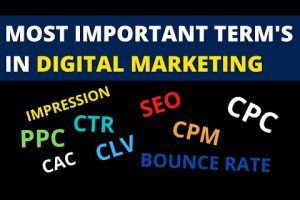
Whether you are a marketing student stepping into the industry, a small business owner managing your first ad campaign, or a seasoned strategist refining your digital playbook, understanding digital marketing terminology is absolutely essential. The landscape of online promotion evolves at breakneck speed, and with it comes an ever-growing lexicon of acronyms, jargon, and specialized phrases that can feel overwhelming. From search engine optimization and cost-per-click advertising to attribution modeling and customer lifetime value, the vocabulary of digital marketing shapes how professionals communicate, strategize, and measure success. This comprehensive guide breaks down the most important terms across three skill levels—beginner, intermediate, and advanced—giving you the confidence to navigate conversations, reports, and strategy sessions like a pro.
What Is Digital Marketing Terminology and Why Does It Matter?
Digital marketing terminology refers to the specialized words, phrases, acronyms, and concepts used across all channels of online promotion—search, social media, email, content, and paid advertising. These terms are not just decorative labels; they serve as the foundation for data-driven decision-making and cross-team collaboration. When a marketer says “CTR dropped below 2%” or “our ROAS improved by 15%,” every stakeholder should understand exactly what that means and what action to take.
Mastering this vocabulary delivers several tangible benefits:

- Clearer communication across teams, clients, and agencies.
- Faster onboarding for new team members and interns.
- Better interpretation of analytics dashboards and campaign reports.
- Improved strategic planning because you can accurately discuss concepts like funnel stages and conversion paths.
- Competitive advantage during interviews, client pitches, and performance reviews.
Think of digital marketing vocabulary the way a doctor uses medical terminology. Precision in language leads to precision in execution.
Core Digital Marketing Terms Every Beginner Should Know
If you are just starting out, building a solid foundation with these fundamental terms will set you up for long-term success. These are the words you will encounter in virtually every digital marketing role.
Search Engine Optimization (SEO) Terminology
SEO stands for search engine optimization, the practice of improving website visibility in organic search results. Key beginner terms include:

- Organic Traffic: Visitors who arrive through unpaid search results rather than paid advertisements.
- Keywords: The specific words or phrases users type into search engines that your content targets.
- Backlinks: Links from external websites pointing to your site, a major ranking signal for Google.
- Meta Description: The brief summary displayed beneath a search result that influences click-through rates.
- SERP: Search Engine Results Page—the page you see after entering a query.
Pay-Per-Click (PPC) and Advertising Terms
PPC campaigns form the backbone of many digital advertising strategies. Understanding these terms is critical from day one:
- CTR (Click-Through Rate): The percentage of people who click your ad after seeing it, calculated as clicks divided by impressions.
- CPC (Cost Per Click): The amount you pay each time someone clicks your ad.
- Quality Score: Google Ads’ rating of your ad’s relevance and landing page quality, which affects ad position and cost.
- Ad Rank: The value determining your ad’s position, based on bid amount and quality score.
- Conversion Rate: The percentage of visitors who complete a desired action, such as purchasing or signing up.
Social Media and Content Marketing Vocabulary
Social platforms and content strategies introduce their own set of essential terms:
- Engagement Rate: The ratio of interactions (likes, comments, shares) to total reach or followers.
- Impressions: The number of times your content is displayed, regardless of whether it was clicked.
- Reach: The number of unique users who saw your content.
- Content Pillars: Core themes or topics that guide a brand’s content strategy over time.
- UGC (User-Generated Content): Content created by customers or fans rather than the brand itself.
Intermediate-Level Digital Marketing Vocabulary
Once you have the basics down, you will encounter more nuanced terms that bridge execution and strategy. These are the phrases that separate someone who runs campaigns from someone who truly understands them.
Performance Metrics and Attribution
Attribution modeling is the framework you use to assign credit to different touchpoints along a customer journey. Without it, you cannot accurately determine which channel—email, social, paid search—deserves credit for a sale. Common models include:
- Last-Click Attribution: Gives full credit to the final interaction before conversion.
- First-Click Attribution: Credits the very first touchpoint that brought the user into the funnel.
- Linear Attribution: Distributes credit equally across all touchpoints.
- Data-Driven Attribution: Uses machine learning to assign weight based on actual conversion data.
Another critical intermediate term is ROAS (Return on Ad Spend), which measures revenue generated for every dollar spent on advertising. Unlike ROI, which considers all costs, ROAS focuses specifically on ad spend efficiency.
Audience and Funnel Concepts
Understanding how audiences move through the marketing funnel requires fluency in these terms:
- Top of Funnel (TOFU): Awareness-stage content that introduces your brand to new prospects.
- Middle of Funnel (MOFU): Consideration-stage content like case studies and comparison guides.
- Bottom of Funnel (BOFU): Decision-stage content such as demos, free trials, and testimonials.
- Remarketing: Targeting users who previously visited your site but did not convert.
- Lookalike Audience: A new audience built from the characteristics of your existing best customers.
- Churn Rate: The percentage of customers who stop using your product or service over a given period.
Advanced Digital Marketing Jargon for Seasoned Professionals
For experienced marketers and agency leaders, advanced terminology reflects strategic sophistication and technical depth. These terms often come up during executive presentations, performance reviews, and complex campaign architectures.
Strategic and Measurement Terms
Customer Lifetime Value (CLV or LTV) estimates the total revenue a business can expect from a single customer throughout the entire relationship. Calculating LTV correctly involves factoring in average purchase value, purchase frequency, and gross margin. Pairing LTV with customer acquisition cost (CAC) gives you a powerful ratio that determines whether your marketing spend is sustainable.
Incrementality Testing is a rigorous methodology used to prove causation rather than mere correlation. By running controlled experiments—often geo-based holdout tests—marketers can isolate the true impact of a campaign from organic demand or other external factors. This approach is increasingly valued because last-click attribution alone rarely tells the whole story.
Multi-Touch Attribution (MTA) extends beyond simple rule-based models by using algorithmic approaches to weight every touchpoint. While powerful, MTA requires robust data infrastructure and statistical expertise to implement correctly.
Emerging and Technical Terms
The digital marketing ecosystem continues to evolve, and with it come new terms that every forward-thinking professional should know:
- Cookieless Future: The ongoing industry shift away from third-party tracking cookies toward privacy-first identification methods.
- Server-Side Tracking: A data collection method that bypasses browser-level restrictions, improving data accuracy and compliance.
- First-Party Data: Information collected directly from your own audience through website behavior, CRM records, and customer interactions.
- Zero-Party Data: Data that consumers intentionally and proactively share with your brand, such as preferences and survey responses.
- Programmatic Advertising: The automated buying and selling of ad inventory using real-time bidding and algorithms.
Digital Marketing Terminology Quick-Reference Table
| Term | Abbreviation | Definition |
| Search Engine Optimization | SEO | Practice of improving organic search visibility |
| Cost Per Click | CPC | Price paid for each ad click |
| Click-Through Rate | CTR | Ratio of clicks to impressions |
| Return on Ad Spend | ROAS | Revenue generated per advertising dollar |
| Customer Lifetime Value | CLV / LTV | Total predicted revenue from a customer |
| Cost Per Acquisition | CPA | Average cost to acquire one customer |
| Cost Per Mille | CPM | Cost per thousand ad impressions |
| User-Generated Content | UGC | Content created by customers or fans |
| Lookalike Audience | — | Audience matching characteristics of top customers |
| Remarketing | — | Re-engaging past website visitors |
| Multi-Touch Attribution | MTA | Algorithmic credit assignment across touchpoints |
| Incrementality Testing | — | Controlled experiment to measure true campaign impact |
Practical Tips for Mastering Digital Marketing Terminology
Memorizing a glossary is one thing; applying it fluently is another. Here are expert-backed strategies to internalize digital marketing vocabulary effectively:
- Create a personal glossary document. Every time you encounter an unfamiliar term, jot it down with your own definition and a real-world example from your work.
- Read industry publications weekly. Publications like Search Engine Journal, Marketing Land, and HubSpot’s blog consistently use and explain current terminology in context.
- Practice explaining terms out loud. If you can explain ROAS or incrementality testing to a non-marketer, you truly understand it.
- Build dashboards with labeled metrics. Seeing terms like “bounce rate” and “session duration” in actual analytics tools reinforces understanding far more than reading definitions alone.
- Join marketing communities. Slack groups, LinkedIn communities, and Reddit forums expose you to how real professionals use these terms in everyday conversation.
Frequently Asked Questions (FAQs)
What is the difference between ROAS and ROI in digital marketing?
ROAS measures revenue returned for every dollar spent specifically on advertising, while ROI calculates overall profit relative to total investment, including operational costs, salaries, and tools. ROAS gives you a channel-specific efficiency metric, whereas ROI provides a holistic view of profitability.
What does incrementality testing mean in digital marketing?
Incrementality testing is a controlled experiment designed to measure the true causal impact of a marketing campaign by comparing outcomes between a test group (exposed to the campaign) and a holdout group (not exposed). It helps marketers avoid over-crediting or under-crediting specific channels.
Why is first-party data becoming more important in digital marketing?
With the phase-out of third-party cookies and increasing privacy regulations like GDPR and Apple’s App Tracking Transparency, first-party data—collected directly from customer interactions—has become the most reliable and compliant foundation for targeting, personalization, and measurement.
What is the best way to learn digital marketing terminology fast?
The fastest approach combines structured learning (certification courses from Google, Meta, or HubSpot) with daily immersion—reading case studies, reviewing campaign reports, and participating in marketing forums where professionals use these terms in real context.
How often does digital marketing terminology change?
The core vocabulary remains relatively stable, but new terms emerge regularly as platforms introduce features (like Google’s Privacy Sandbox) and industry shifts create demand for new concepts (such as “cookieless future” and “server-side tracking”). Staying current requires consistent engagement with the field.
Can understanding digital marketing terminology improve my campaign performance?
Absolutely. When you deeply understand the terminology, you can spot inefficiencies others miss—whether a declining CLV signals a retention problem or a low ROAS indicates audience targeting issues. Vocabulary fluency translates directly into sharper strategic thinking and better resource allocation.
Final Thoughts on Digital Marketing Terminology
Digital marketing terminology is far more than a collection of acronyms and buzzwords. It is the shared language that drives strategy, alignment, and measurable growth across every channel. Whether you are just beginning your journey or refining expertise at an advanced level, investing time in truly understanding these terms—rather than simply memorizing definitions—will set you apart as a thoughtful, effective marketer. Build your personal glossary, practice explaining concepts in context, and never stop learning. The professionals who thrive in digital marketing are those who speak the language fluently and use it to make better decisions every single day.